
Revenue Governance for Medicare Advantage & Capitated Providers in Southern California
Royalty Medical Billing Firm helps providers see the full revenue picture—not just individual claims. We align traditional RCM with Medicare Advantage, capitation, IPA requirements, payer responsibility, RAF/HCC, coding, documentation, encounter data, denials, A/R, and operational workflows so every part of the revenue process works together. When these functions operate in silos, revenue gets missed. We bring them into alignment, uncover the gaps, and give providers the expert oversight needed to strengthen performance, protect reimbursement, and make more informed revenue decisions.
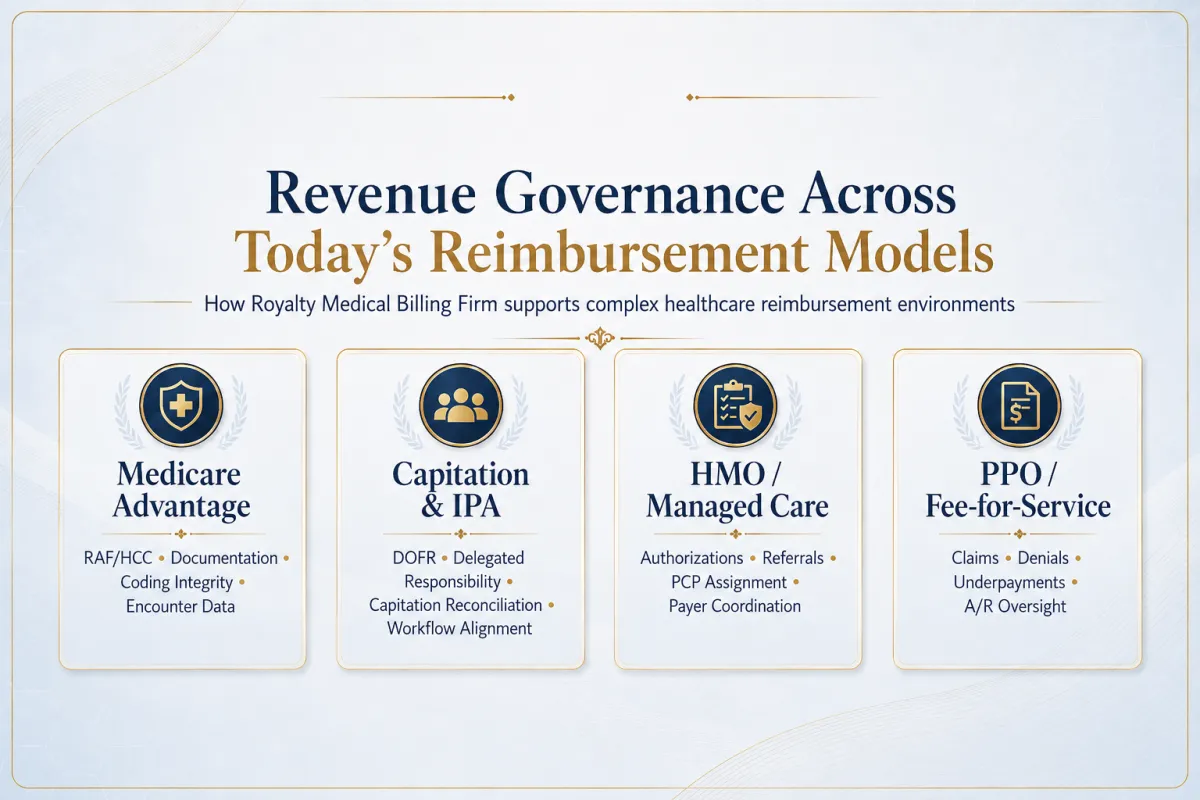
Healthcare reimbursement has changed — billing alone is no longer enough. Yes, we handle the essential work: claims submission, payment posting, denial follow-up, A/R management, coding support, and day-to-day revenue cycle functions. But the real work often lives in the areas you cannot easily see.
That is where Royalty Medical Billing Firm goes deeper. We take a comprehensive look at the processes behind your revenue — payer requirements, contracts, capitation, Medicare Advantage, RAF/HCC, documentation, coding integrity, compliance, encounter data, authorizations, underpayments, and operational workflows — to identify gaps, uncover risk, and bring the pieces into alignment.
We do not simply manage the revenue cycle. We govern the process behind it so your practice has greater visibility, stronger controls, and a clearer understanding of where your revenue stands and what may be getting missed. 👊
Who We Serve
Royalty Medical Billing Firm works with independent providers, physician practices, specialty groups, clinics, and healthcare organizations that need greater visibility and control over their revenue cycle.
Our services are especially relevant for:
Primary care physicians
Internal medicine practices
Family medicine providers
Multi-provider medical groups
Specialty practices
Behavioral health providers
Allied health organizations
Independent clinics
Medicare Advantage providers
IPA-affiliated providers
Capitated medical practices
Providers participating in value-based reimbursement arrangements
Our primary service areas include:
Riverside County, San Bernardino County, and Los Angeles County, with particular attention to independent and community-based providers navigating increasingly complex payer relationships.
When Traditional Medical Billing Is No Longer Enough
Traditional revenue cycle management has historically centered on a familiar process: verify coverage, document the encounter, code the services, submit the claim, receive payment, work denials, and follow the remaining accounts receivable.
That process still matters—but for Medicare Advantage and capitated providers, it represents only part of the financial picture.
A practice may have clean claims and relatively low denial rates while still experiencing revenue leakage through:
Underpayments
Incomplete or unsupported risk-adjustment documentation
Missed HCC recapture opportunities
Incorrect payer or IPA responsibility
Unrecognized contract variances
Encounter data issues
Authorization failures
Inaccurate capitation reconciliation
Services performed outside the practice's financial responsibility
Missed separately reimbursable services
Coding or documentation deficiencies
Unmanaged aging accounts receivable
This is why we believe revenue performance must be evaluated as an interconnected healthcare operation—not simply as a billing function.
For practices participating in Medicare Advantage, HMO, IPA, capitation, or value-based arrangements, the question is no longer simply:
“Did we get paid?”
The stronger questions are:
Were we paid correctly?
Was the service our financial responsibility?
Did the documentation accurately reflect the patient's condition and complexity?
Was the encounter reported appropriately?
Did the payer perform according to the contract?
And can leadership see where revenue is being lost before the loss becomes an A/R problem?
Where Does Royalty Fit In?
Royalty Medical Billing Firm sits between traditional billing and the broader systems that determine whether revenue is actually being captured, supported, paid, and protected.
We handle the day-to-day revenue cycle functions practices expect, but our real value comes from examining the areas that standard billing alone may not uncover.
How We Support Your Revenue
Traditional Revenue Cycle Management
Claims submission, payment posting, denial management, A/R follow-up, eligibility, coding support, charge review, and reimbursement tracking.Revenue Cycle Auditing
Review claims, payments, denials, aging, coding patterns, reimbursement trends, and workflow performance to identify revenue leakage and operational weaknesses.Compliance & Coding Integrity
Evaluate documentation, coding accuracy, medical necessity, NCCI edits, LCD/NCD requirements, payer policies, and other compliance considerations that affect reimbursement.Medicare Advantage & RAF/HCC Support
Review workflows surrounding chronic-condition documentation, HCC capture, annual recapture, coding specificity, clinical support, encounter reporting, and compliant risk-adjustment processes.Capitation & IPA Revenue Oversight
Evaluate capitation workflows, IPA requirements, delegated responsibilities, DOFR, encounter data, referrals, authorizations, and reconciliation processes.Payer Alignment & Contract Analysis
Compare payer requirements, fee schedules, contract terms, expected reimbursement, and actual payments to identify underpayments, discrepancies, or opportunities for further review.Denial & Underpayment Analysis
Go beyond simply working denials by identifying patterns, root causes, recurring payer issues, and preventable workflow breakdowns.Revenue Intelligence & Analytics
Turn billing and reimbursement data into usable information so leadership can clearly see where revenue stands, where it is delayed, and where additional attention is needed.Operational Workflow Alignment
Examine how scheduling, eligibility, authorizations, documentation, coding, billing, payment posting, denials, and follow-up interact so problems are corrected at the source—not just after they affect payment.
Why Practices Use Royalty
Standard Fee-for-Service: Going Beyond Basic Billing
In a traditional fee-for-service environment, Royalty Medical Billing Firm goes beyond clean claims, payment posting, and denial follow-up. We evaluate whether the entire claim is supported from a clinical, coding, compliance, and reimbursement perspective. The objective is not simply to get a claim paid, but to make sure the service, documentation, coding, medical necessity, and payment all align.
Medical Necessity Review — Evaluate whether the documented service supports payer coverage requirements and applicable medical necessity standards.
Documentation Integrity — Review whether the medical record supports the level and type of service billed.
Coding Standards — Assess ICD-10-CM, CPT, modifier use, coding specificity, and applicable coding guidelines.
LCD/NCD Alignment — Review Local and National Coverage Determinations when relevant to the service.
NCCI Review — Identify potential bundling, edit, and modifier issues that may affect reimbursement.
Utilization Review — Examine service patterns, frequency, and utilization concerns that may create payer scrutiny or reimbursement risk.
Authorization & Referral Compliance — Review whether required approvals, referrals, and payer-specific processes were followed.
Denial Root-Cause Analysis — Look beyond reworking denials to identify recurring operational, coding, documentation, or payer-related causes.
Underpayment Review — Compare expected reimbursement with actual payment and identify potential payment variances.
A/R Performance — Evaluate aging, follow-up activity, payer trends, and recoverability of outstanding balances.
The result is a stronger revenue cycle where billing, documentation, compliance, and reimbursement work together instead of operating as separate functions.
Medicare Advantage & Capitation: Governing the Entire Revenue Model
In Medicare Advantage and capitated environments, the revenue picture becomes more complex. Royalty Medical Billing Firm evaluates the relationship between clinical documentation, RAF/HCC risk adjustment, capitation terms, payer responsibility, encounter reporting, IPA requirements, compliance, and actual financial performance. We look at whether the physician’s documentation supports the conditions being managed and whether the practice’s operational and financial workflows are aligned with the terms of the capitated arrangement.
RAF/HCC Documentation Review — Evaluate whether chronic and significant conditions are appropriately documented, supported, and captured.
MEAT Review — Assess whether conditions are being monitored, evaluated, assessed/addressed, or treated when applicable and appropriately supported in the medical record.
Annual Recapture Processes — Review workflows for identifying and appropriately documenting conditions that require ongoing annual evaluation.
Coding Specificity & Clinical Support — Examine whether diagnosis coding accurately reflects the documented clinical picture.
Encounter Data Oversight — Review whether encounters and diagnoses are being captured, reported, and transmitted appropriately.
Capitation Terms Review — Examine contractual terms, PMPM arrangements, payment methodologies, and applicable payer or IPA standards.
DOFR Analysis — Review the Division of Financial Responsibility to determine which entity is responsible for specific services.
Delegated Responsibility Review — Evaluate whether operational workflows align with delegated payer, IPA, or medical group responsibilities.
Carve-Out Identification — Identify services that may fall outside the standard capitated arrangement or require separate reimbursement.
Capitation Reconciliation — Compare expected membership, payments, and contractual terms against actual capitation received.
Authorization & Referral Requirements — Review whether referral, authorization, and network requirements are being followed appropriately.
Separately Reimbursable Services — Identify services that may be payable outside of the capitated payment structure.
Audit & Compliance Readiness — Evaluate whether documentation, coding, risk-adjustment, and operational processes are prepared for payer or regulatory review.
Revenue & Risk Analysis — Identify areas where gaps in documentation, reporting, payer responsibility, or contract interpretation may create financial loss or compliance exposure.
This is where Revenue Governance™ becomes especially important. We connect the clinical, operational, compliance, and financial sides of the practice so leadership can understand not only what was paid, but why it was paid, whether the payment was correct, and where revenue or risk may still be hidden.
Healthcare Reimbursement Has Changed. Your Revenue Strategy Should Too.
In today’s healthcare economy, providers are working harder than ever to deliver excellent care while navigating rising operating costs, staffing pressures, payer requirements, regulatory expectations, and increasingly complex reimbursement models. With that much responsibility on the table, your practice cannot afford to leave revenue behind.
Healthcare reimbursement has changed, and your revenue strategy has to change with it. Getting claims out the door is no longer enough. Practices need to understand whether services are supported, coded correctly, medically necessary, reimbursed according to contract, aligned with payer requirements, and captured through workflows that protect both revenue and compliance.
The real financial risk often lives in the areas that are not immediately visible—underpayments, documentation gaps, missed reimbursement opportunities, capitation discrepancies, payer responsibility issues, incomplete risk capture, authorization failures, and operational breakdowns that quietly erode revenue over time.
That is why a modern revenue strategy requires more than billing. It requires oversight, analysis, alignment, and accountability across the entire process.
Every dollar should have a reason, a process, and a path to payment.
The Royalty Standard™ in Revenue Governance
Healthcare organizations need more than someone who submits claims.
They need visibility.
They need accountability.
They need payer knowledge.
They need operational discipline.
They need documentation and coding integrity.
And they need a revenue strategy that reflects how healthcare is actually reimbursed today.
That is the purpose behind The Royalty Standard™ in Revenue Governance.
We don't manage revenue. We govern it.
Your Revenue. Our Priority. | Value-Based. Always.
Start With a Revenue Conversation
If your practice participates in Medicare Advantage, capitation, an IPA, an HMO, or other value-based arrangements, Royalty Medical Billing Firm can help you take a closer look at the processes behind your revenue.
Start with a complimentary Revenue Snapshot and identify where additional review may be needed.
Royalty Medical Billing Firm
Healthcare Operations • Revenue Cycle Management • Revenue Optimization Consulting
Toll-Free: 888-547-4744
Local: 951-629-1617
Website: royaltymedicalbillingfirm.com
Stay Ready, So You Don't Have To Get Ready!
Scan QR
Complimentary Revenue Governance Snapshot.

